‘He’s getting back to being the happy boy he was’: Meet Frank
13 Apr 2026, 1:51 p.m.
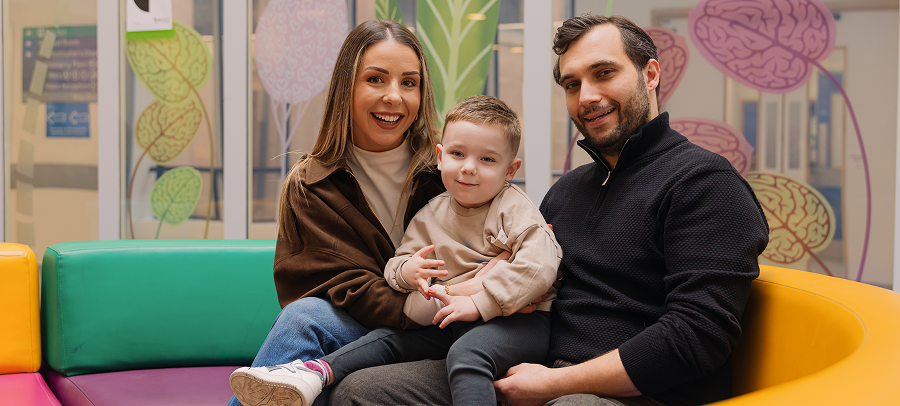
When he was 15 months old, Frank was diagnosed with a rare type of cancerous brain tumour. He was treated at Great Ormond Street Hospital (GOSH) and is now in remission.
His mum, Emily, shares their story.
Three-year-old Frank loves cars
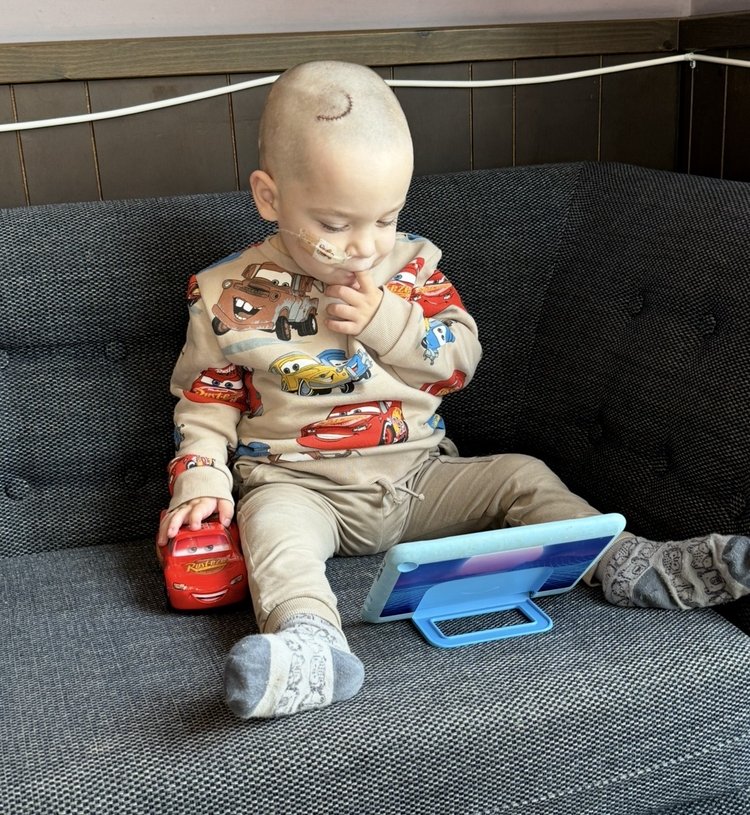
In fact, Frank watches the film Cars every day, multiple times a day. His bedroom is fully Cars-themed, complete with a wall painting. He always has a toy car in each hand, even when crawling.
“That’s him at his happiest,” Emily says. “If you're walking down a road, and a car goes past, Frank always says, ‘Wow!’ He’s mesmerised by them. That's just what his life is, really.”
The early signs of childhood cancer
Frank had no symptoms until about two weeks before his diagnosis.
In May 2024, when he was 15 months old, he started being sick in the mornings. He was also very drowsy but could only sleep when he was sitting upright on his mum.
Then, he stopped eating and moving around as much as he normally would. Frank, Emily and Frank's dad, Josh, went back and forth to a local GP practice, but except for a chest infection, doctors couldn’t find anything wrong.
Still, Frank’s symptoms continued to get worse, so his parents took him to accident and emergency. He was admitted to the hospital, where doctors ordered a range of tests.
‘It was terrifying’
Unfortunately, the morning after Frank arrived at the hospital, he had a seizure.
“His whole body just suddenly jolted backwards from me,” Emily remembers. “I’d never seen anything like it. I thought I'd lost him. The emergency buttons were pressed, and everyone ran into the room. It was horrendous.”
Frank had a scan, which showed a tumour and a build-up of fluid on his brain. He needed to go to GOSH immediately for specialist care, but he first had to be put into an induced coma.
“Frank had a high risk of having a stroke, and if he did, his body wouldn't survive it,” Emily says. “Before we knew it, the intensive care ambulance arrived, and they put him into the coma. It was terrifying to see him suddenly under all those machines.”
Straight into emergency brain surgery at GOSH
When Frank and his parents arrived at GOSH, the neurosurgical team was waiting.
They rushed Frank straight from the ambulance into theatre for emergency surgery. During the surgery, doctors fitted a temporary drain into his brain, so fluid could be released.
A few days after Frank had the drain fitted, the team at GOSH brought him out of his coma. Then it was time for another surgery – to remove the tumour on his brain.
“The day before the surgery, we sat down with our neurosurgeon,” Emily remembers. “They told us that from an MRI scan, they could see the tumour had grown around all the nerves in the back of Frank’s head – the ones that relate to his speech, his swallowing, his sight and his hearing. They said there was a high chance he’d be severely disabled if those nerves were damaged during surgery.”
On 29 May 2024, Frank had the tumour removed. He was in surgery for 11 hours.
Support for families facing childhood cancer
A week later, doctors told Frank’s parents that the tumour was a Grade 3 ependymoma, a rare type of brain tumour.
“Even then, I had to ask, ‘Is that cancer?’” Emily recalls. “Frank couldn't sit up or speak or move by himself, and we still had no idea whether there was any lasting damage from the surgery. To then be told your son has brain cancer, it was just horrific.”
Frank stayed in GOSH for the whole of June to recover. During this time, Frank worked with Speech and Language therapists, the Physiotherapy team and occupational therapists. He also spent time with the charity-funded Play team, who help make hospital a little bit easier and a lot more fun for seriously ill children.
“The Play team were amazing because for such a long time, Frank couldn't get up and go to the playroom,” Emily says. “They used to come in and bring him toys. They were just incredible. They were there to make our lives easier and Frank's life happier.”
Frank couldn’t talk, but towards the end of his stay, he began to smile. He wanted to play more, and he began to wave to some of his favourite nurses. Emily remembers a particularly sweet moment with them.
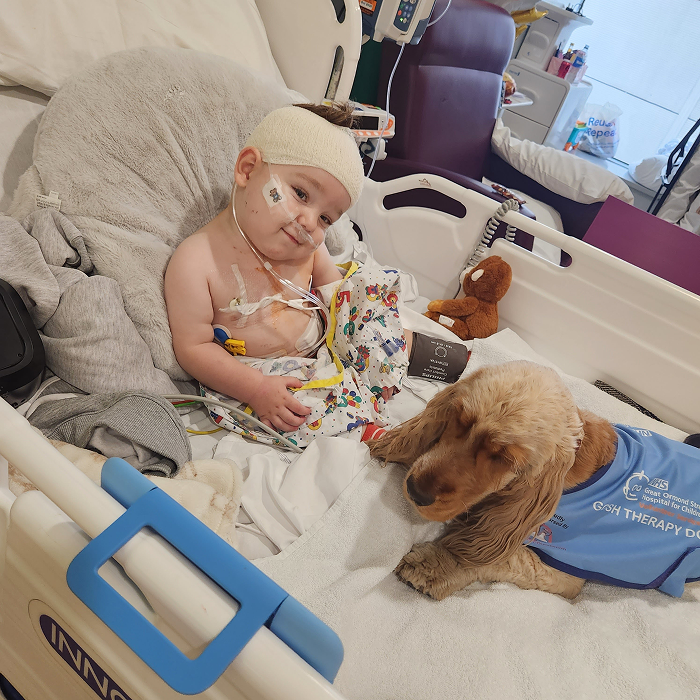
“One day the nurses put a towel on the bed so a therapy dog could lay next to Frank,” Emily says. “He absolutely adored it. I’ve got the most beautiful photos of Frank smiling the best smile we'd seen for weeks and weeks, just looking at this dog.”
Treatment continued
Frank’s older sisters, Olivia and Sophia, were thrilled when he was able to come home. But it was also overwhelming for his parents: there were a lot of medications and new things to learn.
And new challenges. After the 11-hour surgery, Frank began to suffer from seizures. He’s since been diagnosed with epilepsy.
“It was really daunting, and normal life just didn’t seem normal,” Emily says. “Suddenly we were medical parents, and that wasn't something that I ever thought would happen.”
The next step for Frank was to have proton beam therapy, a type of radiotherapy, at another hospital to treat the cancer. But after the treatment finished, Frank became very unwell again and had to return to GOSH.
Doctors discovered that his shunt, a thin tube they’d put in his brain during his first stay at GOSH, was draining too fast. Frank needed to have a programmable shunt fitted – a type of shunt which uses a specialised magnetic device on the skin. This allows the shunt to be adjusted without surgery.
“It's absolutely amazing what GOSH did with the shunt. It helped so much. Frank changed pretty much overnight. He went from being a poorly little boy, not eating or drinking, just holding his head, crying and having seizures to getting up again and playing. He wanted to communicate with us.”
‘We’re just so grateful’
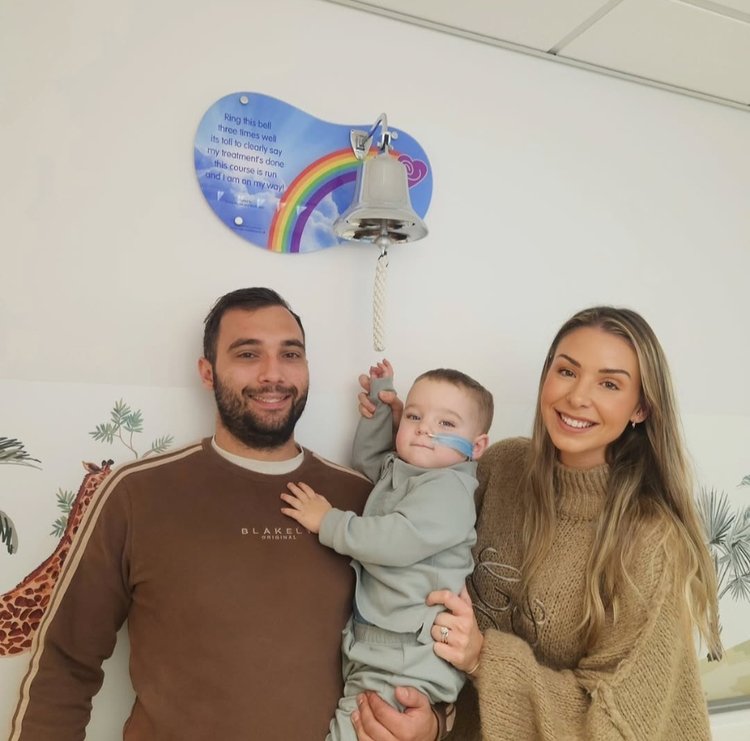
Frank’s now in remission, and his cancer treatment has finished. He’s back at nursery, and is, according to his mum, a “cheeky little boy”.
“If you’d told me in May 2024 that we’d be celebrating Frank’s birthday and Christmas, I probably wouldn't have believed you because I saw my boy attached to millions of wires and on a life support machine,” Emily says.
“We had some really hard conversations at times and I did think, ‘Are we actually going to come through this?’ To get to the other side and celebrate milestones is amazing. We’re just so grateful.”
Still, Frank’s journey isn’t over. He continues to have temperatures and seizures. He was at GOSH last September to have a new shunt fitted as well, but since his symptoms haven’t improved, he’s been referred to other medical teams.
Having cancer has impacted Frank in other ways, too.
“Being unwell, it’s even impacted how Frank eats,” Emily says. “He doesn't want to pick up messy food or do messy play, because at the age when he should have been playing in the garden or in sand, he wasn't able to.”
The Children’s Cancer Centre
Every year, around 1,900 children in the UK are diagnosed with cancer.*
Cancer doesn’t care about childhood. It doesn’t care what seriously ill kids miss out on, or how much you want to protect them. But we do.
That’s why we’re building a new, world-leading Children’s Cancer Centre at GOSH. With cutting-edge facilities and an environment where pioneering research can thrive, the centre will offer children far more than a hospital.
Emily’s particularly excited about the outdoor spaces the centre will include, so children and families can have access to fresh air. And she says having everything together in one place will make a big difference.
“It looks like it's going to be absolutely incredible."
* Source: Cancer Research UK