GOSH Charity-funded research offers hope for children with devastating genetic kidney disease
13 Aug 2026, 3:11 p.m.
Children born with a rare genetic kidney disease called glomerular disease often face kidney failure before their third birthday. With no treatments currently able to stop the disease getting worse, many children need dialysis and, eventually, a kidney transplant.
Now, research funded by Great Ormond Street Hospital Charity (GOSH Charity) in partnership with LifeArc has taken an important step towards changing that.
A team led by Dr Jennifer Chandler, Professor David Long and Dr Saif Malik from the UCL Great Ormond Street Institute of Child Health (UCL GOS ICH) has pioneered a new treatment that can slow the disease before kidney failure develops. Read the full paper, published in Science Translational Medicine.
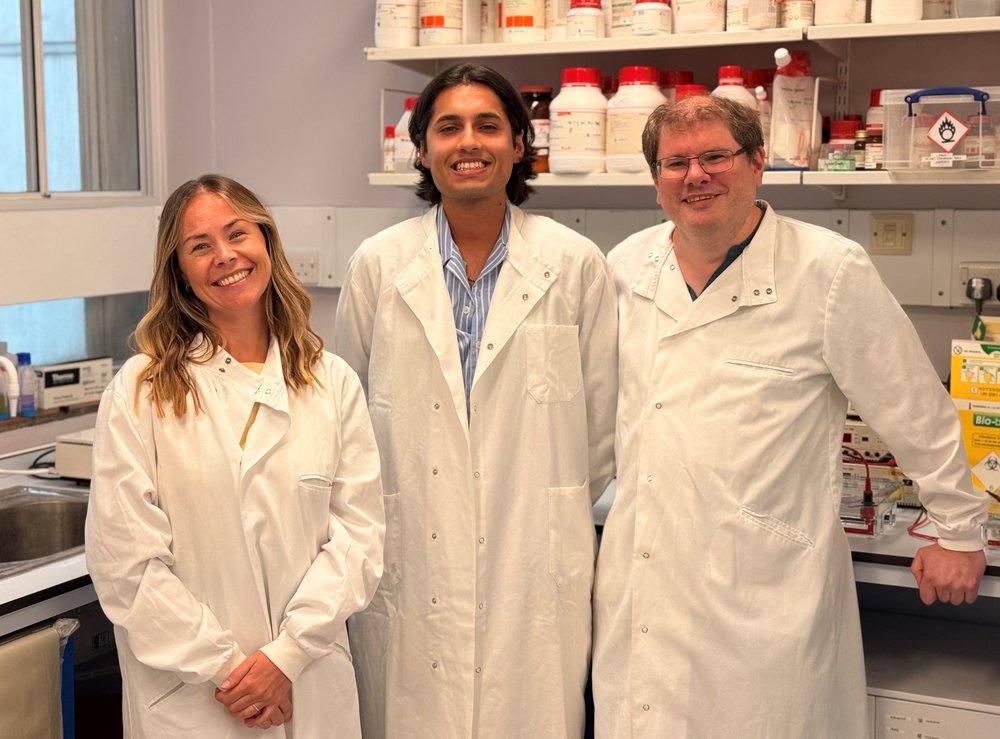
The research team behind the breakthrough (from left to right: Dr Jennie Chandler, Dr Saif Malik and Prof David Long).
Protecting the kidney's tiny filters
The disease affects tiny structures in the kidneys called glomeruli. These microscopic filters clean the blood, keeping important proteins in the body while removing waste.
In children with certain inherited genetic changes, these filters become damaged. As they break down, protein leaks into the urine, healthy kidney cells are lost and permanent scarring develops. Over time, the kidneys stop working properly.
For affected children and their families, the consequences are life-changing. Children often need regular dialysis to do the job their kidneys can no longer manage, before eventually needing a kidney transplant.
A new way to deliver RNA therapy
The new treatment is an RNA (ribonucleic acid) therapy, which gives the body's cells instructions to make a protective protein. Children with glomerular disease have low levels of this protein, so restoring it could help keep the kidney's tiny blood vessels healthy and support its filtering function.
The researchers also developed a new way to deliver the treatment.
Rather than injecting it into the bloodstream, where much of it can travel elsewhere in the body, they delivered the RNA directly into the kidney's blood supply using a minimally invasive, ultrasound-guided injection.
This targeted approach meant more of the treatment reached the damaged kidney tissue, while reducing its effects elsewhere in the body.
Encouraging results
So far, the treatment has only been tested in mice, and much more research is needed before it can be tested in children. But these findings are an important early step towards developing the first treatment that could slow this devastating disease.
Made possible by GOSH Charity funding
This research was supported by a Translational Research Accelerator Grant, awarded in 2022 by GOSH Charity in partnership with self-funded medical research charity LifeArc. Other funders, including Kidney Research UK also played a key role in supporting the researchers behind this pioneering work.
GOSH Charity also supports Dr Jennifer Chandler through an Emerging Leaders Fellowship, helping develop the next generation of clinician-scientists working to transform children's healthcare.
“This truly is a landmark piece of work in the field of novel therapies for childhood kidney disorders. Charities, such as GOSH Charity, are incredibly important when it comes to work such as this. Without their support, research that might otherwise never have happened becomes possible."
By funding pioneering research projects and the talented researchers behind them, GOSH Charity is helping to take discoveries from bench to bedside, giving children with some of the rarest and most challenging conditions the best chance and the best childhood possible.